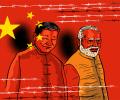
The reasons for China's negative response are located in its territorial dispute with India but also to its grand designs of dominating the region from its previous position of being merely a "balancer" between India and Pakistan, points out Srikanth Kondapalli, Professor in Chinese Studies at JNU.
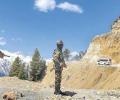
'India is not going to accept whatever the Chinese say. That is not going to happen.'

The seventh Tibet Work Forum was held in Beijing on August 28 and 29. Delhi should be deeply concerned, at a time India faces a precarious situation in Ladakh, because the TWF also defines China's western border policies, observes Claude Arpi.
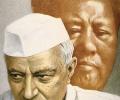
'Delhi was not concerned.' 'It would continue sleeping for several more years, with the result that Indian territory is still occupied by China today,' says Claude Arpi.

A disgruntled ex-convict, arrested for the recent serial bomb blasts targeting China's ruling Communist Party's provincial headquarters in Taiyuan, carried out the attack to "take revenge on society", police said on Friday.
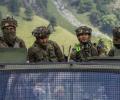
Today, the Ladakhis and Tibetans have been joined by the Sikhs, the Madrassis, the Garhwalis, the Rajputs, who are well trained psychologically and otherwise, to defend the nation, observes Claude Arpi.

The strategic Karakoram Highway, which links Kashghar in Xinjiang with Gilgit and Abbottabad through the KhunjerabPass, has been damaged at more than 50 places from Gojal to Besham, leaving hundreds of commuters and over 50 foreign tourists stranded.

'Tibetans will participate in future conflicts with India (in all probability, some were already present in Galwan).' 'As nobody in India would like to have a deadly fight with Tibetan soldiers and officers, the issue needs to be closely followed,' observes Claude Arpi.

We bring you a collection of some of the best photographs taken this week by ace photographers.

Major General Sujan Singh Uban, a legendary veteran of the Second World War, was a natural choice to raise, train and command the Special Frontier Force and mould them into a well oiled fighting machine, recalls his son Inspector General Gurdip Singh Uban (retd), who led SFF troops during the Kargil War.
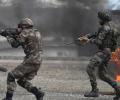
'Post the pandemic, when India is turning a new leaf in its economic policy with an eye on foreign capital and global supply chains that are likely to leave China, heightened tensions on the India-China border creates an atmosphere of uncertainty,' observes Virendra Kapoor.

Important for India was Xi's meeting with representatives of PLA officers and soldiers stationed in Tibet. The video of the encounter was interesting to watch, especially the large number of lieutenant generals and major generals, observes Claude Arpi.

'If the US intention was to use the FATF platform to isolate Pakistan and impose sanctions against it, that is not going to work when influential countries such as Turkey, Iran, Saudi Arabia, China and Russia will not lend support to the US campaign,' says Ambassador M K Bhadrakumar.
'Once accession to Pakistan appeared unlikely, the British instituted Operations Gulmarg and Datta Khel respectively to foil possible accession to India.'
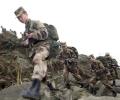
After frequent incursions in Ladakh area, Chinese People's Liberation Army troops have been spotted at forward posts along the Line of Control on the Pakistani side of Kashmir, ringing alarm bells in the security grid.

Awesome photos of the month: February Here are some of the best photographs clicked across the globe in the month of February.

'There are major implications for India. Though there was a transparently thin attempt to project the troop reduction as intended to promote peace, the downsizing is actually part of plans to streamline and strengthen the PLA, capable of defending China's national interests at home and abroad,' says Jayadev Ranade.

Armed forces and the police can only ensure that violence is kept under control but for any kind of lasting peace, politicians will have to find an answer to the perception that the Indian State is anti-Islam. Therein lies the biggest challenge to the Modi government, says Colonel Anil A Athale (retired).

Imagine being a part of a country, but being discriminated against by the majority community and atrocities being committed against you by the state. This is the deplorable conditions that the Rohingyas of Myanmar live in where they are cut off from their livelihoods and sources of income, unable to access markets, hospitals and schools, and have little or no access to relief aid. In order to understand the situation and the genesis of the tragedy unfolding, Rediff.com's Archana Masih speaks to Ambassador Vijay Nambiar, the United Nations' Chef de Cabinet (Chief of Staff), who had served a long stint with the UN in New York on the issue.

'It is a pattern of behaviour of the Chinese that whenever a Chinese leader visits India or an Indian leader visits China, some incidents take place.' 'When Modi visits China, we should look out for some similar demonstration by the Chinese.'
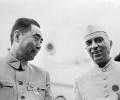
The Indians felt that if they acceded to Chinese claims in Ladakh, Beijing would simply be emboldened to press for further concessions in the future. A revealing excerpt from India And The Cold War.

China is spending billions of dollars to improve infrastructure in Tibet and other parts of its border with India. Claude Arpi explains why New Delhi can't afford to ignore Beijing's plans.
'If we had sent a few airplanes (into Tibet), we could have wiped the Chinese out.' 'And everything could have been different in the 1962 War.' 'They did not believe me there was no Chinese air force.' 'Can you imagine what would have happened if we had used the IAF at that time?' 'The Chinese would have never dared do anything down the line.'

'The focus on countering terrorism brings to the issue Beijing's non-serious approach in this regard. India's permanent representative at the UN has raised in vain the issue of funding and the release of 26/11 suspect Zaki-ur Rehman Lakhvi. But China has blocked these objections since December 2014 at the UN even after 'highest levels' in India intervened,' notes Srikanth Kondapalli, reviewing the India-China military exercises in Kunming.

'The military aim in a future conflict, if it can't be avoided, should be to cause maximum damage to the adversary's war waging capability and capture limited amount of territory as a bargaining counter,' says Brigadier Gurmeet Kanwal (retd).

Some stunning moments of the week that was

What India has failed to acknowledge is that sub-conventional war is the name of the game and irregular forces have emerged with greater strategic value over conventional and even nuclear forces, and reliance purely on conventional force and diplomacy is grossly inadequate, says Lt Gen Prakash Katoch (retired).

It is a dark legacy bequeathed by Nehru to India. In its DNA lies the subconscious fount of India's schizophrenic geopolitics that forsook in one sweep all its historically-entrenched strategic interests in Tibet in favour of China, says R N Ravi, on the 60th anniversary of the Panchsheel Agreement.

'They are not affected by ISIS' sentiment of avenging the suffering of the global ummah.' 'They have a huge ummah of their own in India, a huge Muslim population.' 'And because of that, they have to take into consideration the political and social conditions of Muslims in India.' 'They have to express themselves in a more political way and not through terrorism.'

President Xi Jinping's visit may put relations between India and China on a new trajectory

'China's excessive military aid to Pakistan is the real elephant in the room as far as Sino-Indian relations are concerned. India should be confident enough to accept a degree of closeness between China and Pakistan, since China may wish to use this link for its foray into the Muslim world.' 'But the Chinese must be realistic enough to know that as time passes, the tactic of using Pakistan as a proxy to check India will yield diminishing returns. The US tried it for 60 years but failed, so will China,' says Colonel Anil A Athale (retd).
 © 2026 Rediff.com - Advertise with us - Disclaimer - Privacy Policy - Sitemap - Feedback - About us - Terms of use - Grievances